
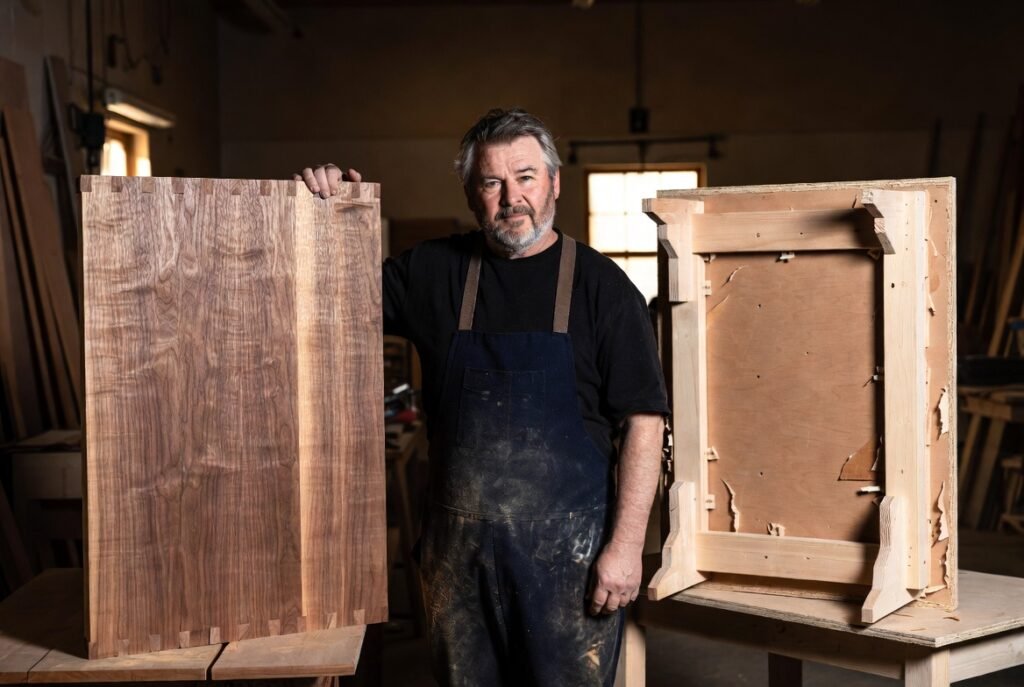
Hey there, friends. Grab a coffee and pull up a chair — preferably one made of real wood.
I’ve been building furniture in Stratford for a long time, and if there’s one question I get asked more than anything, it’s this: “Why should I spend more on solid wood when I can get something cheap from IKEA or big-box stores?”
Fair question. So let me tell you the truth from a guy who’s spent decades with his hands on the stuff.
It Comes Down to How It’s Built
When I build a table, a shelf or a dresser, I’m not rushing to hit a price point. I’m building it like my reputation depends on it — because it does.
Solid wood furniture is joined together with real craftsmanship: mortise and tenon joints, dovetails, or solid screws and plugs. These connections are strong and designed to last. When wood moves (and it will move with the seasons here in Ontario), good joinery moves with it instead of fighting against it.
Mass-produced furniture? Most of it is made with particleboard, MDF, or cheap plywood held together with glue, staples, and plastic connectors. That stuff looks decent on day one, but after a few years — especially with our humid summers and bone-dry winters — it starts to swell, crack, and fall apart.
I’ve taken apart plenty of old Stratford-made pieces from the 1920s that are still rock solid. Try finding an IKEA piece from 15 years ago that’s still in good shape.
The Wood Itself Makes All the Difference
Real wood has character. It has grain, strength, and beauty that only improves with age. A good walnut or cherry table develops a deep, rich patina over time. Scratches and dings tell the story of family dinners, kids doing homework, and holiday gatherings.
Particleboard and laminate? They don’t age gracefully. They chip, peel, and look tired fast. Once that veneer is damaged, there’s no sanding it out and refinishing it. It’s done.
You Can Actually Repair Solid Wood
This is a big one for me.
If my grandson bangs into the leg of a solid oak table I built, I can fix it. I can sand it, patch it, refinish it, and it’ll look great again. A piece I built 25 years ago can still be going strong 25 years from now.
With most flat-pack furniture, once it’s broken or the joints loosen, it’s headed for the landfill. There’s no real way to repair it properly.
The Real Cost Over Time
Sure, that cheap dresser might save you money today. But how many times will you have to replace it over the next 30 years?
A well-made solid wood piece costs more upfront, but it becomes cheaper in the long run. It’s like buying good tools — you cry once when you pay for them, then smile every time you use them for the next 40 years.
We Build for Ontario Life
Here in Stratford and across Southwestern Ontario, our furniture has to handle real life: kids, dogs, big family dinners, cottage weekends, and four distinct seasons. That’s why we use proper hardwoods and time-tested construction methods.
We’re not building disposable furniture. We’re building pieces you’ll hand down to your kids one day.
So next time you’re thinking about furniture, ask yourself: Do I want something that’ll look good in the Instagram photo, or something that’ll still be standing strong when my grandkids are fighting over who gets it?
If you want the second option, you know where to find me.
— From the bench of Scott Fritz
Thinking about investing in furniture that will actually last? Drop by our Stratford showroom or send us a message. We’d be happy to talk about what solid wood can do for your home.